
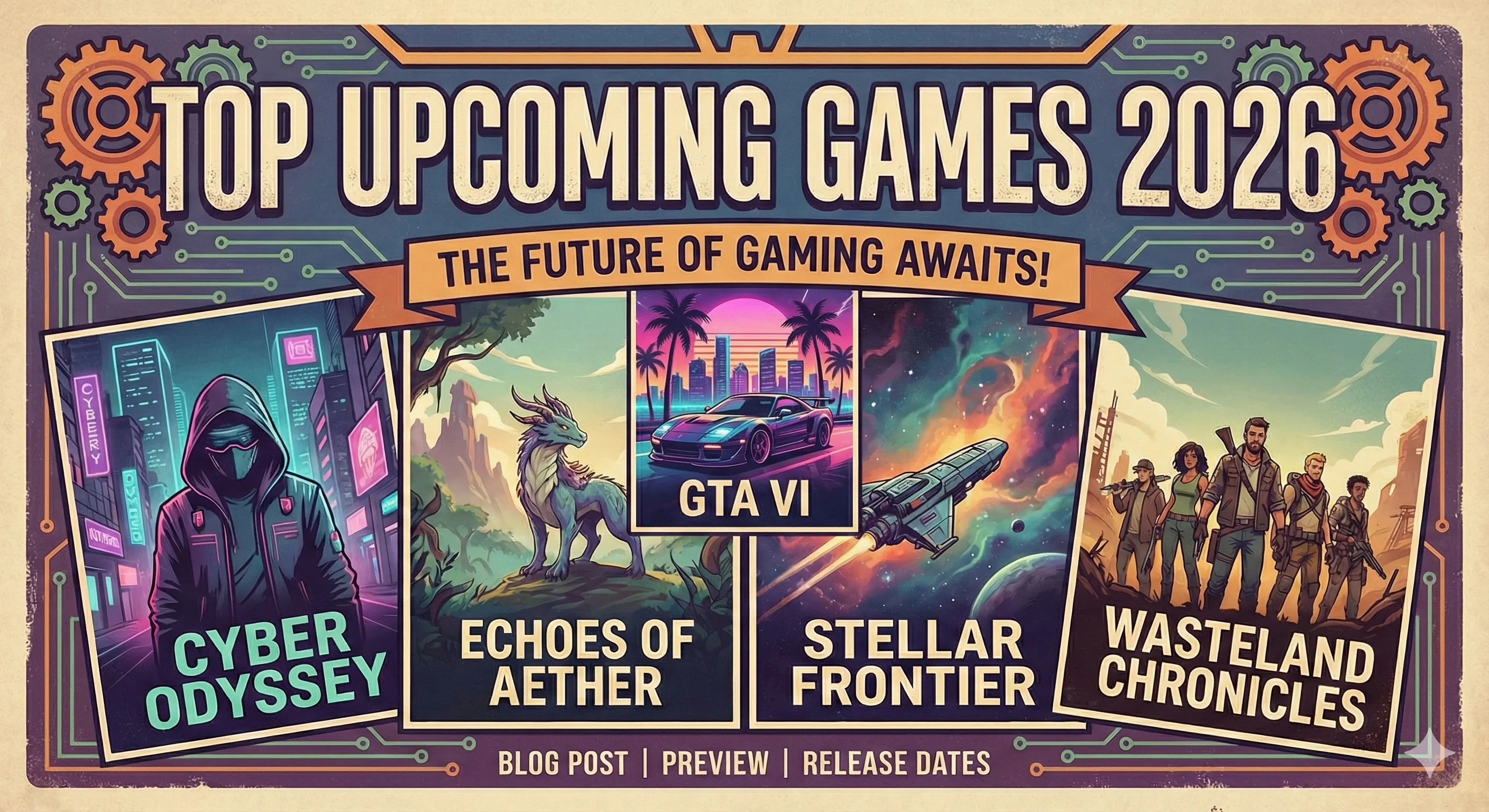
Top Upcoming Games to Watch in 2026: The Year Gaming Gets Serious Every year brings promises of greatness in gaming, but 2026 stands apart as something special. After years of development delays, cross-generation compromises, and studios finding their footing with new technology, we're finally seeing the industry hit its stride. The upcoming slate features not just highly anticipated sequels from beloved franchises but also bold new IPs and indie projects that could redefine what we expect from games. Whether you're drawn to massive open worlds, narrative-driven adventures, competitive multiplayer, or experimental indie experiences, 2026 offers something extraordinary. This is our comprehensive guide to the games that will dominate conversations, capture imaginations, and potentially reshape the medium over the next twelve months.
Blockbuster Releases: The Heavy Hitters
The biggest studios are bringing their most ambitious projects to fruition in 2026, with releases that promise to push technical boundaries and set new standards for production value and scope.
Grand Theft Auto VI (Q2 2026)
Rockstar Games returns to Vice City with arguably the most anticipated game in history. After the record-breaking success of GTA V and over a decade of development, expectations couldn't be higher.
Dual Protagonists: Play as Lucia and Jason in an interconnected crime saga
Next-Gen Exclusive: Built from the ground up for PlayStation 5, Xbox Series X/S, and PC
Living World: Dynamic systems creating unprecedented environmental and NPC realism
Expanded Online: GTA Online 2 launching alongside with fresh approach to multiplayer
GTA VI represents more than just another entry in a popular franchise—it's a cultural event that will dominate gaming discourse for years. The modern Vice City setting promises Rockstar's signature satire applied to contemporary issues, while the technical showcase demonstrates what current hardware can truly achieve. If any game can justify its decade-long development cycle, this is it.
The Elder Scrolls VI (Late 2026)
Bethesda finally brings the long-awaited sequel to Skyrim, setting the RPG in the provinces of Hammerfell and High Rock with a scope that dwarfs previous entries.
Dual Province Setting: Explore vast deserts and coastal kingdoms in unprecedented detail
Creation Engine 3: Rebuilt technology enabling larger cities and more complex systems
Dynamic Factions: Player choices reshape power structures across the region
Enhanced Modding: Tools designed with community creators in mind from day one
The Elder Scrolls VI carries the weight of following one of gaming's most beloved RPGs. Bethesda promises a return to the exploration-focused design that made Skyrim special while addressing criticisms about repetitive dungeons and shallow quest design. The political intrigue between Hammerfell and High Rock provides narrative opportunities for moral complexity beyond simple good versus evil conflicts.
Final Fantasy XVII (Summer 2026)
Square Enix debuts the next mainline Final Fantasy with a steampunk setting and revolutionary combat system that blends real-time action with tactical depth.
Industrial Fantasy: Magitek revolution transforms traditional fantasy world
Paradigm Combat: Switch between action and strategic modes seamlessly mid-battle
Airship Exploration: Customizable vessel serving as hub and means of discovery
Political Drama: Story explores industrialization's impact on magic and society
Final Fantasy XVII marks Square Enix's attempt to unite divided fans by offering combat that satisfies both action enthusiasts and tactical strategists. The steampunk aesthetic provides fresh visual identity while maintaining series traditions through summons, crystals, and epic storytelling. Early previews suggest a return to ensemble casts with meaningful party dynamics rather than focusing predominantly on a single protagonist.
Assassin's Creed: Rising Sun (Q3 2026)
Ubisoft finally delivers the long-requested Feudal Japan setting with a game that reimagines the franchise's stealth and parkour mechanics for an era of samurai and shinobi.
Dual Gameplay Styles: Play as samurai or ninja with distinct mechanical approaches
Sengoku Period: Navigate political intrigue during Japan's warring states era
Honor System: Actions affect reputation and available story paths
Cultural Authenticity: Extensive consultation ensuring respectful representation
Rising Sun represents Ubisoft's most focused Assassin's Creed in years, scaling back the massive open worlds of recent entries for denser, hand-crafted environments. The choice between honorable samurai combat and shadowy ninja tactics promises meaningful gameplay variety while the setting's historical richness provides narrative depth. If Ubisoft can deliver on its promises of cultural authenticity and mechanical refinement, this could revitalize the franchise.
Story-Driven Experiences: Narrative Excellence
For players who value compelling storytelling and emotional resonance, 2026 brings several narrative-focused games from studios known for exceptional writing and character development.
Control 2: Resonant (Q1 2026)
Remedy Entertainment expands Jesse Faden's story as Director of the Federal Bureau of Control while deepening connections to their shared universe of supernatural fiction.
Reality Fractures: Paranatural phenomena escaping containment across America
Expanded Powers: New abilities manipulating time, space, and perception
Cooperative Mode: Optional two-player experience tackling threats together
Connected Universe: Direct narrative ties to Alan Wake and other Remedy games
Control 2 builds on the original's success by taking the supernatural threats beyond the Oldest House's brutalist corridors into diverse American landscapes. Remedy promises their most ambitious storytelling yet, weaving multiple narrative threads across their game universe while delivering the reality-bending action that made Control special. The addition of cooperative play opens new possibilities for shared storytelling without compromising the solo experience.
Star Wars: Eclipse (Spring 2026)
Quantic Dream takes players to the High Republic era with a choice-driven adventure exploring the Jedi Order at its peak and the shadows threatening galactic peace.
Multiple Protagonists: Experience interconnected stories from diverse perspectives
Consequential Choices: Decisions ripple across storylines and shape galactic events
High Republic Setting: Explore untold era of Star Wars history
Cinematic Presentation: Quantic Dream's signature visual storytelling
Eclipse represents Quantic Dream's most ambitious project, combining their narrative expertise with Star Wars' mythological richness. The High Republic setting provides creative freedom unavailable in more familiar eras, while the multi-protagonist approach allows exploration of how individual actions contribute to larger historical movements. For fans seeking story-driven Star Wars experiences beyond lightsaber combat, Eclipse promises something genuinely different.
The Last of Us Part III (Fall 2026)
Naughty Dog concludes Ellie's journey in the emotionally devastating finale that promises to challenge everything players think they understand about the series' themes of survival and humanity.
Narrative Conclusion: Definitive ending to Ellie's story spanning two decades
Evolved Infected: New threats reflecting the fungal infection's continued evolution
Faction Warfare: Navigate conflicts between survivor communities
Mature Themes: Exploration of redemption, legacy, and breaking cycles of violence
The Last of Us Part III faces the challenge of concluding a story that has already explored the depths of human darkness and resilience. Naughty Dog promises a finale that provides closure while honoring the complexity that made the series resonate so deeply. Early information suggests themes of finding purpose beyond survival and whether redemption is possible after unforgivable acts—heavy material that will undoubtedly spark passionate discourse.
Senua's Saga: Ragnarök (Q2 2026)
Ninja Theory completes Senua's journey with a game exploring Norse mythology's end times while continuing to portray psychosis with unprecedented sensitivity and authenticity.
Ragnarök Setting: Experience the Norse apocalypse through Senua's perspective
Mental Health Focus: Continued collaboration with mental health organizations
Enhanced Audio: Binaural sound design creating unsettling immersion
Mythological Encounters: Face gods and monsters from Norse tradition
Ninja Theory's commitment to portraying mental illness with accuracy and empathy sets Senua's Saga apart from typical action adventures. The Ragnarök setting provides narrative framework for Senua's internal battles manifesting as external conflicts, while maintaining the series' uncomfortable intimacy through its close camera and visceral combat. This isn't escapist entertainment but rather challenging art that demands emotional engagement.
Multiplayer and Live Service: Competitive Arenas
For players seeking social experiences and ongoing competition, 2026 brings new multiplayer games and expansions to existing favorites that promise to dominate streaming platforms and social conversations.
Overwatch 3 (Spring 2026)
Blizzard reboots their hero shooter again with lessons learned from Overwatch 2's rocky transition, promising a return to the game's competitive roots with fresh content.
Reimagined Roster: All heroes rebalanced for modern competitive ecosystem
New PvE Mode: Story-driven cooperative missions finally delivered as promised
Fair Monetization: Battle pass and cosmetics only, gameplay content free
Competitive Focus: Ranked system overhaul prioritizing skill expression
Overwatch 3 represents Blizzard's attempt to rebuild trust with a community alienated by Overwatch 2's controversial decisions. The promise of meaningful PvE content addresses a major complaint while competitive improvements aim to recapture the game's esports glory days. Success depends on whether Blizzard can balance these priorities without sacrificing either competitive integrity or casual accessibility.
Destiny 3: The Final Shape (Q3 2026)
Bungie launches the next chapter of Destiny with a clean slate, new engine, and lessons from a decade of live service operation informing every design decision.
Fresh Start: New power system letting players carry forward meaningful progress
Expanded Universe: Multiple star systems with distinct civilizations and threats
Buildcrafting Depth: Enhanced customization creating diverse viable playstyles
Accessibility Options: Solo-friendly paths to endgame content alongside group activities
Destiny 3 faces the challenge of evolving the formula while maintaining what makes the series special. Bungie's decision to move to a new engine enables technical improvements impossible in the current game while the narrative reset provides entry points for new players intimidated by years of lore. For veterans, the promise of meaningful progression carryover respects their investment while fresh systems prevent stagnation.
Battlefield 7 (Fall 2026)
DICE returns to form with a Battlefield focused on what the series does best—large-scale combined arms warfare with destructible environments and emergent chaos.
Near-Future Setting: Contemporary conflicts extrapolated with believable technology
128-Player Battles: Massive maps designed for scale without feeling empty
Enhanced Destruction: Improved Frostbite engine enabling unprecedented environmental chaos
Tactical Teamwork: Systems encouraging squad coordination over lone wolf play
Battlefield 7 represents DICE's chance to redeem the franchise after Battlefield 2042's disappointing launch. The focus on combined arms warfare and environmental destruction returns to series roots while the near-future setting provides creative freedom without the balancing challenges of historical accuracy. If DICE can deliver stable servers and well-designed maps at launch, this could restore Battlefield's position as the premier large-scale multiplayer shooter.
Marvel Rivals: Season 2 (Ongoing 2026)
NetEase's hero shooter continues its first year with expanding roster, new maps, and seasonal content keeping the Marvel universe fresh for competitive players.
Growing Roster: New heroes added regularly from across Marvel's vast catalog
Comic-Inspired Events: Seasonal content based on major Marvel storylines
Competitive Scene: Official esports support with substantial prize pools
Cross-Progression: Play seamlessly across platforms with shared progress
Marvel Rivals has quickly established itself as a legitimate competitor in the hero shooter space. The Marvel license provides virtually unlimited character possibilities while NetEase's commitment to balance and fair monetization has won player goodwill. As the game enters its second year, maintaining this momentum while expanding the competitive scene will determine whether Rivals achieves long-term success or becomes another forgotten hero shooter.
RPG Excellence: Deep Systems and Rich Worlds
Role-playing game enthusiasts have much to celebrate in 2026, with multiple studios delivering the deep, systems-driven experiences that define the genre at its best.
Divinity: Fallen Heroes (Q2 2026)
Larian Studios returns to the franchise that established their reputation, bringing lessons from Baldur's Gate 3 to create their most ambitious original RPG yet.
Tactical Innovation: Enhanced environmental interaction and combat systems
Four-Player Co-op: Full campaign playable with friends in asymmetric roles
Branching Consequences: Choices affecting not just story but fundamental mechanics
Modding Support: Robust tools for community-created content and campaigns
Divinity: Fallen Heroes represents Larian's chance to apply everything they learned from Baldur's Gate 3's massive success to their own IP. The darker tone and focus on fallen civilizations provide narrative weight while the enhanced cooperative systems promise meaningful collaboration rather than just shared combat. For fans who want Baldur's Gate 3's depth in an original setting, this delivers.
Avowed: Dawnshore Expansion (Q1 2026)
Obsidian Entertainment expands their Pillars of Eternity action RPG with a massive content addition exploring new regions of Eora and deepening the main game's systems.
New Region: Explore the mysterious Dawnshore and its ancient civilizations
Enhanced Magic: New spellcasting schools and soul-bending abilities
Companion Quests: Deep character arcs for returning and new party members
Level Cap Increase: Progress further with new abilities and build options
The Dawnshore expansion demonstrates Obsidian's commitment to supporting Avowed beyond launch with substantial content rather than cosmetic additions. The new region provides fresh exploration while system enhancements address player feedback about build diversity and combat depth. For those who finished Avowed and craved more of Eora's rich lore, Dawnshore delivers exactly what the game's world-building promised.
Dragon Age: Dreadwolf (Summer 2026)
BioWare returns to Thedas with a single-player RPG focused on narrative choice and companion relationships while addressing criticisms of recent entries' live service elements.
Solas Confrontation: Deal with the consequences of Inquisition's companion turned antagonist
Tactical Combat: Strategic depth returning with pause and command systems
Romance Options: BioWare's signature companion relationships with mature writing
World State Import: Choices from previous games shaping Thedas's current state
Dragon Age: Dreadwolf represents BioWare's attempt to recapture the magic of Origins and Inquisition while evolving the formula for modern audiences. The focus on Solas as antagonist provides narrative continuity for long-time fans while the return to tactical combat addresses complaints about action-focused design in recent entries. Success could revitalize BioWare as a premier RPG studio; failure might mark the end of Dragon Age's run.
Crimson Desert (Q3 2026)
Pearl Abyss's ambitious action RPG finally arrives with a massive open world blending survival elements, political intrigue, and visceral combat that builds on Black Desert Online's foundation.
Reactive World: Dynamic faction system where player actions reshape power structures
Survival Mechanics: Resource management and environmental hazards adding challenge
Action Combat: Refined from Black Desert with accessibility improvements
Mercenary Story: Narrative following group struggling to survive political upheaval
Crimson Desert's long development has allowed Pearl Abyss to craft something more ambitious than typical open-world RPGs. The survival elements add tension to exploration while the faction system creates emergent political narratives based on player choices. If the combat successfully balances Black Desert's complexity with broader accessibility, Crimson Desert could establish a new standard for action RPGs.
Indie Innovations: Creative Risks and Fresh Ideas
Independent developers continue proving that innovation doesn't require blockbuster budgets. These indie games promise unique experiences unavailable from major publishers.
Hollow Knight: Silksong (Q1 2026)
Team Cherry finally releases the eagerly anticipated sequel to their beloved metroidvania, starring Hornet in a new kingdom with expanded mechanics and scope.
New Protagonist: Play as Hornet with unique abilities and movement options
Pharloom Kingdom: Entirely new setting with distinct visual identity and lore
Enhanced Combat: More aggressive playstyle with new weapons and tools
Quest System: NPCs offering missions providing structure alongside exploration
Silksong's extended development has only increased anticipation for Team Cherry's follow-up to one of the indie scene's biggest successes. The shift to Hornet as protagonist enables fresh gameplay while maintaining the tight controls and beautiful art direction that made Hollow Knight special. For metroidvania fans, this represents the genre's most anticipated release in years.
Hades III (Spring 2026)
Supergiant Games continues Zagreus's mythology-inspired adventures with new pantheons, enhanced roguelike systems, and the studio's signature narrative integration.
Expanded Mythology: New pantheons beyond Greek gods offering fresh interactions
Refined Combat: More weapon variety and boon combinations creating build diversity
Relationship Depth: Deeper character arcs and romance options across runs
Co-op Mode: Optional two-player experience maintaining narrative coherence
Hades set a new standard for roguelikes by proving narrative and permadeath can coexist meaningfully. The third entry expands this formula by incorporating mythologies beyond Greek tradition while deepening the systems that made previous games so replayable. Supergiant's track record suggests this will be another masterclass in game design where every element reinforces the whole.
The Wandering Village (Full Release Q2 2026)
Stray Fawn Studio's unique city builder exits early access with a complete campaign where you build settlements on the back of a massive wandering creature through toxic wastelands.
Living Foundation: Build on creature's back requiring consideration of its needs
Symbiotic Relationship: Care for Onbu while it carries your village to safety
Environmental Hazards: Navigate toxic spore clouds and hostile territories
Campaign Narrative: Story mode providing structure alongside sandbox play
The Wandering Village's novel premise translates into genuinely unique gameplay challenges unavailable in traditional city builders. Balancing village needs with Onbu's health creates engaging tension while the mobile nature prevents static optimization strategies. The full release promises to deliver the complete vision with narrative context explaining this world's mysteries and the relationship between humanity and these gentle giants.
Fabledom: Kingdoms Expansion (Q3 2026)
The cozy fairytale city builder receives its biggest content update with new factions, diplomatic systems, and expanded romance mechanics creating storybook kingdoms.
New Factions: Additional kingdoms with unique architectural styles and abilities
Enhanced Diplomacy: Marriage alliances, trade agreements, and political intrigue
Seasonal Events: Festivals and celebrations adding life to settlements
Expanded Campaign: New story scenarios with moral choices affecting kingdom development
Fabledom carved a niche by combining city building with storybook charm and romance elements typically absent from the genre. The Kingdoms expansion deepens what makes the game special—creating emergent narratives through gameplay systems rather than scripted events. For players seeking relaxing yet engaging strategy experiences, this represents the genre's most wholesome offering.
Replaced (Spring 2026)
Sad Cat Studios' retro-futuristic platformer finally releases after stunning reveal trailers showcased its unique pixel art aesthetic and narrative-driven action.
AI Protagonist: Play as artificial intelligence in human body navigating dystopian city
Pixel Perfection: Gorgeous hand-drawn pixel art with fluid animation
Narrative Focus: Story-driven experience exploring consciousness and humanity
Cinematic Platforming: Set pieces blending exploration, puzzle-solving, and combat
Replaced stands out through its commitment to visual excellence and thoughtful narrative exploration of transhumanist themes. The retro-future aesthetic provides striking contrast between classic pixel art techniques and modern lighting effects while the AI protagonist enables philosophical questions about identity and consciousness. For indie game enthusiasts seeking artistic experiences, Replaced promises something genuinely special.
Unexpected Returns: Revived Franchises
Several dormant franchises make surprising returns in 2026, bringing beloved properties back with modern sensibilities while respecting what made them special originally.
Perfect Dark (Q2 2026)
The Initiative and Crystal Dynamics revive Rare's classic spy shooter with modern mechanics, environmental storytelling, and Joanna Dark's return to espionage action.
Modern Espionage: Contemporary setting with near-future technology and surveillance themes
Immersive Sim Elements: Multiple approach options to missions rewarding creativity
Enhanced AI: Intelligent enemies adapting to player tactics
Asymmetric Multiplayer: Innovative competitive modes building on original's legacy
Perfect Dark's revival represents Xbox's attempt to establish new flagship franchises by modernizing classics. The immersive sim influences suggest a game that respects player intelligence and creativity rather than demanding specific solutions. If The Initiative can capture the original's innovation while updating for modern sensibilities, this could establish Perfect Dark as relevant for a new generation.
Legacy of Kain: Soul Reaver (Remake Q3 2026)
Crystal Dynamics lovingly recreates one of gaming's most celebrated gothic adventures with modern graphics while preserving the original's atmospheric storytelling and dimension-shifting gameplay.
Visual Overhaul: Complete graphical remake maintaining original's gothic atmosphere
Preserved Gameplay: Dimension-shifting mechanics refreshed but fundamentally unchanged
Enhanced Narrative: Original voice acting remastered with additional context scenes
Quality of Life: Modern conveniences without compromising original design philosophy
The Legacy of Kain remake represents the ideal approach to reviving classic games—respecting what made them special while updating elements that aged poorly. Crystal Dynamics' involvement ensures knowledge of the source material while modern technology allows the gothic vampire fantasy to achieve visual splendor the original could only suggest. For fans who remember Soul Reaver fondly and newcomers curious about this legendary series, the remake provides the perfect entry point.
Splinter Cell: Echelon (Fall 2026)
Ubisoft brings Sam Fisher back with a stealth experience that modernizes the franchise's methodical approach while maintaining the patience and planning that defined classic entries.
Pure Stealth Focus: No forced combat scenarios respecting player stealth choices
Light and Shadow: Enhanced lighting systems making darkness meaningful again
Gadget Innovation: Modern spy technology providing creative infiltration options
Passing the Torch: Narrative exploring Sam's legacy and new generation of Splinter Cells
Splinter Cell: Echelon represents Ubisoft's promise to return to the franchise's stealth roots after action-focused departures in recent years. The emphasis on pure stealth gameplay respects what made the series special while modern technology enables more sophisticated AI and environmental interaction. For stealth game enthusiasts who've waited over a decade for Sam Fisher's return, Echelon promises to deliver the methodical, challenging infiltration gameplay they've missed.
Wild Cards: The Unpredictable Entries
Some games defy easy categorization, offering experimental mechanics or unusual combinations of genres that make them difficult to predict but impossible to ignore.
Death Stranding 2: On the Beach (Q2 2026)
Hideo Kojima returns to his post-apocalyptic delivery simulator with expanded mechanics, new cast members, and even more ambitious thematic exploration of connection in isolation.
Expanded World: New regions of America rebuilt after Death Stranding events
Vehicle Variety: More transportation options changing traversal strategies
Cooperative Evolution: Enhanced online features strengthening player connections
Kojima Ambition: Even stranger narrative elements exploring human connection
Death Stranding 2 represents Kojima Productions doubling down on what made the original divisive yet beloved. The meditative traversal gameplay and philosophical themes about isolation and connection will either resonate deeply or frustrate players seeking conventional action. Kojima's reputation suggests this will be fascinating regardless of whether it achieves commercial success—sometimes the journey matters more than the destination.
S.T.A.L.K.E.R. 2: Heart of Chornobyl (Q1 2026)
GSC Game World's long-awaited sequel to the cult classic survival shooter series finally arrives with uncompromising difficulty and atmospheric tension.
Enhanced Zone: Larger Chornobyl Exclusion Zone with dynamic anomaly system
Faction Warfare: Complex relationships between survivor groups affecting quests and access
Survival Systems: Hunger, radiation, and equipment degradation creating constant tension
A-Life 2.0: Advanced AI simulation making Zone feel alive and unpredictable
S.T.A.L.K.E.R. 2 refuses to compromise its hardcore survival shooter identity for mainstream appeal. The Chornobyl setting provides haunting atmosphere while the unforgiving systems create genuine survival tension absent from most modern shooters. This isn't for everyone, but for players seeking challenging, atmospheric experiences that respect their intelligence, S.T.A.L.K.E.R. 2 promises something increasingly rare in contemporary gaming.
Pragmata (Summer 2026)
Capcom's mysterious sci-fi project finally reveals its true nature after years of cryptic teasers suggesting ambitious action-adventure with horror elements.
Near-Future Earth: Dystopian setting with advanced technology and societal collapse
Companion Mechanics: Protecting young girl while navigating hostile environments
Zero Gravity Combat: Unique movement and combat in low-gravity environments
Environmental Storytelling: Narrative revealed through exploration and observation
Pragmata represents Capcom's risk-taking with new IP during an era dominated by established franchises. The game's refusal to clearly define its genre or mechanics before release suggests confidence in delivering something genuinely surprising. Whether this gamble pays off depends on execution, but Capcom's recent track record with Resident Evil and Monster Hunter gives reason for optimism.
Conclusion
The year 2026 represents a watershed moment for gaming—a convergence of technological maturity, creative ambition, and industry learning from past mistakes. The games detailed here span every genre, budget level, and design philosophy, offering something for every type of player.
What makes this lineup exceptional isn't just the presence of long-awaited sequels like GTA 6 and The Elder Scrolls VI, though those certainly generate excitement. It's the diversity of experiences represented—from hardcore survival shooters to cozy city builders, from narrative-driven adventures to competitive multiplayer arenas, from blockbuster productions to intimate indie gems. This variety suggests a healthy, mature industry confident enough to serve different audiences rather than chasing a single universal formula.
The independent scene's continued strength alongside major publisher releases demonstrates gaming's unique position among entertainment media. Small teams can achieve cultural impact rivaling massive studios, while established franchises push technical boundaries previously thought impossible. This coexistence of scales and approaches creates an ecosystem where innovation comes from all directions, keeping the medium vital and unpredictable.
Not every game listed here will succeed. Some will disappoint expectations, others will face delays pushing them beyond 2026, and a few might become surprise phenomena nobody anticipated. That uncertainty is part of gaming's excitement—we're participating in a medium still discovering what it can be rather than endlessly repeating established formulas.
As we move through 2026, these games will dominate our conversations, social feeds, and gaming time. They'll provide shared experiences connecting us to friends across distances and create memories we'll revisit for years. Some will achieve commercial success while others find cult followings. A few might genuinely advance the medium, showing us possibilities we hadn't imagined. That potential—the promise that any of these games could be something special—is what makes following gaming's future so compelling.
Which 2026 releases are you most anticipating? Are there games on this list you think are overhyped, or hidden gems you believe deserve more attention? How do you think 2026's lineup compares to previous years? Share your thoughts and predictions in the comments below—we'd love to hear which games you're counting down the days for and why!