
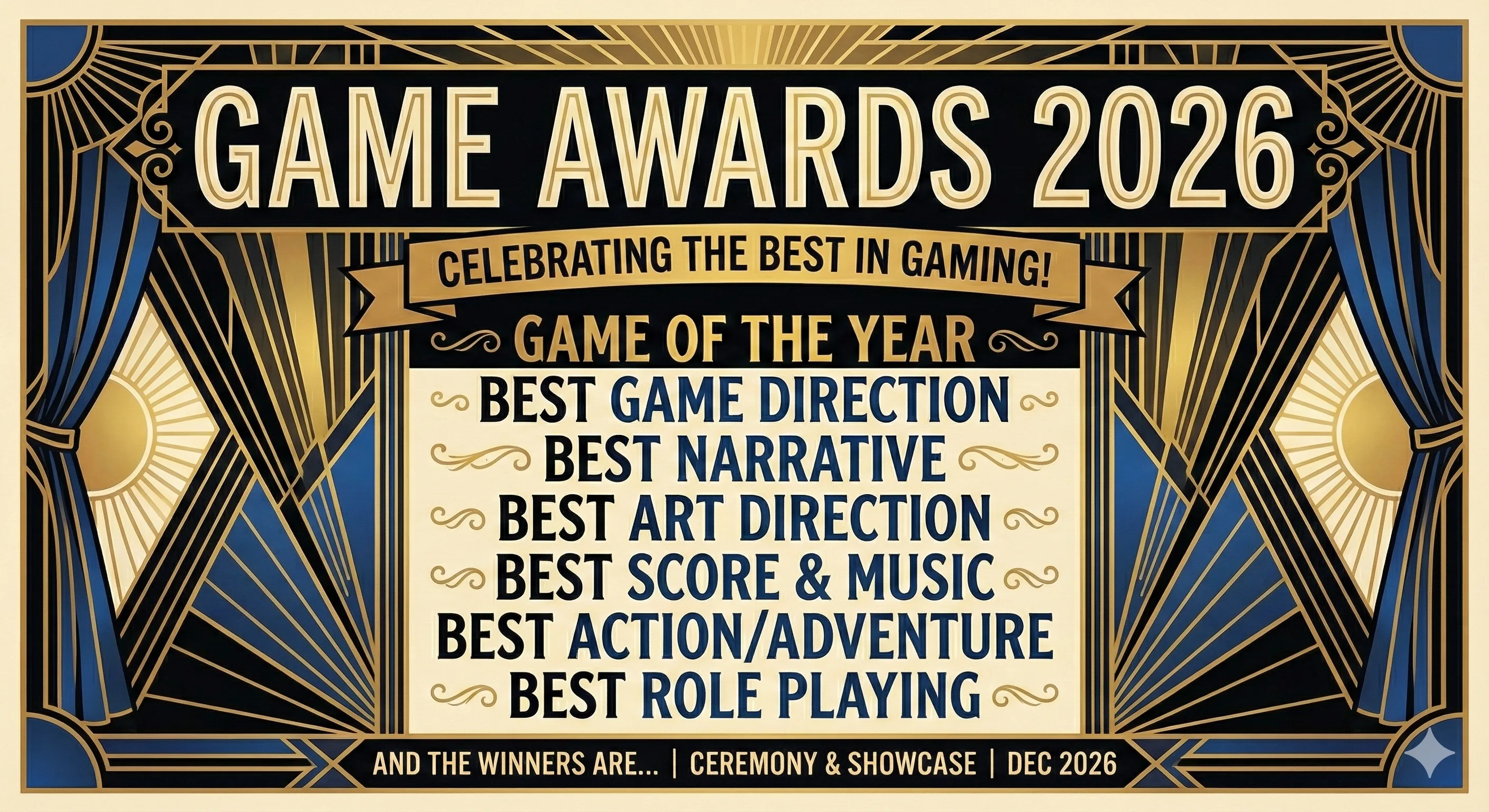
The Game Awards 2026: A Night of Epic Reveals and Gaming's Future The Game Awards has evolved from a simple awards ceremony into gaming's equivalent of the Super Bowl—a spectacle where the industry's biggest players unveil their most ambitious projects. The 2026 edition delivered on that promise with a cascade of announcements that left audiences breathless. From the long-awaited gameplay reveal of GTA 6 to surprise RPG sequels and franchise revivals, the night redefined what we can expect from gaming's immediate future. This wasn't just about celebrating the past year's achievements—it was about witnessing the roadmap for the next era of interactive entertainment.
The Headliner: GTA 6 Takes Center Stage
After years of speculation, carefully orchestrated leaks, and mounting anticipation, Rockstar Games finally pulled back the curtain on Grand Theft Auto 6 with an extended gameplay demonstration that instantly became one of the most-watched moments in gaming history.
Vice City Reimagined
The reveal confirmed what rumors had suggested: GTA 6 returns players to Vice City, but this isn't the neon-soaked playground from 2002. Rockstar's modern interpretation presents a sprawling, living recreation of South Florida that pushes technical boundaries in ways that seemed impossible just years ago.
Dual Protagonists: Players alternate between Lucia and Jason, partners in crime with intertwining narratives
Dynamic World Systems: Weather, traffic, and NPC behavior respond to time, location, and player actions
Unprecedented Scale: The map reportedly exceeds the combined size of GTA 5 and Red Dead Redemption 2
Next-Gen Immersion: Ray-traced lighting, photorealistic character models, and physics systems that simulate reality
The gameplay demonstration showcased moments ranging from tense heist planning to explosive action sequences and quiet character-building scenes that highlighted Rockstar's storytelling prowess. The interaction between Lucia and Jason suggests a relationship-driven narrative that could rival the depth of Red Dead Redemption 2's character dynamics while maintaining GTA's signature satirical edge.
Industry Implications
GTA 6's reveal carries weight beyond just one game's announcement. As Rockstar's first major new release in over a decade, it sets the technical and creative bar for what blockbuster games can achieve:
Development Timeline: Confirms mid-2027 release window after years of development
Platform Strategy: PlayStation 5, Xbox Series X/S, and PC with no last-gen versions
Online Evolution: Hints at GTA Online 2 launching alongside single-player campaign
Cultural Impact: Expected to dominate conversations and sales for years post-launch
The announcement immediately shifted industry dynamics. Publishers adjusted release schedules to avoid competing with GTA 6's launch window, while hardware manufacturers celebrated validation that next-generation console capabilities would finally be fully utilized. For players, the reveal represented the culmination of years of waiting—and confirmation that Rockstar's perfectionist approach might actually deliver something worthy of the anticipation.
RPG Renaissance: Divinity and Beyond
While GTA 6 captured headlines, role-playing game enthusiasts experienced their own moment of triumph with several high-profile RPG announcements that promise to define the genre's next chapter.
Divinity: Fallen Heroes Returns
Larian Studios surprised audiences with the announcement of a new Divinity game, marking their return to the franchise that put them on the map before Baldur's Gate 3 became a cultural phenomenon. The reveal trailer showcased a darker, more combat-focused experience than previous entries.
Tactical Evolution: Enhanced combat systems building on lessons from Baldur's Gate 3
Fallen Empire Setting: Story follows survivors in a collapsed divine civilization
Cooperative Focus: Four-player co-op with asymmetric character abilities
Moral Complexity: Choices without clear good or evil outcomes affecting world state
Larian's announcement emphasized that Fallen Heroes explores themes of power, corruption, and redemption in ways their previous games only hinted at. The studio promised deep branching narratives where player choices reshape not just story outcomes but fundamental game mechanics and character progressions. Early footage demonstrated the environmental interaction systems that made Divinity: Original Sin 2 so beloved, now enhanced with modern graphics and more sophisticated AI companions.
The RPG Lineup Expands
Divinity wasn't the only RPG making waves. The Game Awards became an RPG showcase with multiple genre entries revealing ambitions for 2026 and beyond:
Project Awakening: Cygames' long-dormant action RPG finally showed substantial gameplay
Crimson Desert: Pearl Abyss revealed a 2027 release date with stunning open-world footage
Avowed Expansion: Obsidian announced major post-launch content for their recent release
Indie Surprises: Several smaller studios unveiled unique RPG concepts challenging genre conventions
The breadth of RPG announcements signaled renewed publisher confidence in the genre following Baldur's Gate 3's massive success. Studios are clearly betting that audiences hunger for deep, systems-driven experiences that prioritize player agency and replayability over linear, directed narratives. The competition among these titles promises to push the entire genre forward as developers vie to capture the attention of RPG enthusiasts who now expect nothing less than excellence.
Star Wars: A Galaxy Far, Far Away Returns
Star Wars gaming has experienced a renaissance in recent years, and The Game Awards 2026 continued that momentum with not one but two significant announcements that expand the galaxy's interactive storytelling in exciting directions.
Star Wars: Eclipse Awakens
Quantic Dream's ambitious High Republic-era action adventure finally emerged from development silence with a stunning new trailer and gameplay demonstration. Set hundreds of years before the Skywalker saga, Eclipse promises to explore untold corners of Star Wars lore with Quantic Dream's signature narrative focus.
Multiple Perspectives: Story told through several interconnected characters across the galaxy
High Republic Era: Explores the Jedi at their peak and emerging threats to peace
Choice-Driven Narrative: Player decisions shape galactic events and character fates
Branching Consequences: Actions in one storyline ripple across others in unexpected ways
The reveal dispelled concerns about the project's troubled development, showcasing polished visuals and confident storytelling. Quantic Dream emphasized that Eclipse isn't just another lightsaber combat game but an exploration of what it means to be a guardian of peace when that peace itself becomes contested. The High Republic setting allows fresh storytelling without the constraints of established film canon, giving developers freedom to create truly surprising narrative moments.
Jedi: Fallen Order Trilogy Concludes
Respawn Entertainment announced the third and final chapter in Cal Kestis's journey with a reveal that promises to conclude one of Star Wars gaming's most beloved modern stories:
Narrative Conclusion: Cal's story reaches its climax in the dark times before A New Hope
Expanded Combat: New Force powers and lightsaber styles reflecting Cal's mastery
Open World Elements: Larger, more interconnected environments encouraging exploration
Companion Dynamics: Deeper relationships with returning and new characters
The announcement trailer hinted at darker themes as Cal confronts the reality that the Jedi Order he hoped to rebuild may be impossible in the Empire's iron grip. Respawn teased difficult choices ahead that will test Cal's principles and force players to grapple with the moral complexity of survival versus resistance. The promise of a definitive ending gives the trilogy weight, suggesting Respawn is committed to telling a complete story rather than extending it indefinitely for commercial reasons.
Control Resonant: Remedy's Reality-Bending Return
One of the night's most unexpected announcements came from Remedy Entertainment, who revealed Control Resonant—a direct sequel to their critically acclaimed supernatural action game. The reveal immediately set social media ablaze with theories and speculation.
Expanding the Oldest House
Control Resonant continues Jesse Faden's story as Director of the Federal Bureau of Control, but the brief teaser suggested the game ventures far beyond the brutalist architecture of the Oldest House that defined the first game.
Reality Fractures: The Oldest House's influence spreads to locations across America
Enhanced Abilities: Jesse's powers evolve with new reality-warping capabilities
Multiplayer Integration: Optional co-op mode letting players tackle paranatural threats together
Connected Universe: Direct ties to Remedy's Alan Wake franchise become explicit
The reveal trailer showcased Jesse in various environments—a small-town diner warping into impossible geometries, a forest where trees float in defiance of physics, an abandoned mall where time flows differently in each store. Remedy emphasized that Resonant explores what happens when the Bureau's containment of paranatural phenomena begins failing on a massive scale, threatening to expose the supernatural world to unprepared civilians.
Remedy's Ambitious Vision
Control Resonant represents more than just a sequel—it's a cornerstone of Remedy's interconnected universe of games:
Shared Narrative: Events connect to Alan Wake 2's conclusion and future projects
Technical Showcase: Northlight engine upgrades pushing destruction and physics further
Accessibility Focus: Extensive options ensuring wider audience can experience the story
Long-Term Support: Post-launch expansions already planned expanding the narrative
Remedy's decision to announce Control Resonant now suggests confidence in their expanded universe approach. The studio is betting that audiences will embrace interconnected storytelling across multiple games, creating a Marvel-like continuity for their supernatural fiction. For fans who've followed Remedy's work for decades, this represents the culmination of narrative threads stretching back to the first Max Payne, now finally weaving together into something larger than any individual game.
Ace Combat 8: Taking Flight Again
Flight combat enthusiasts rejoiced when Bandai Namco unveiled Ace Combat 8 with a trailer emphasizing both the series' trademark arcade accessibility and a commitment to pushing aerial warfare simulation further than ever before.
Evolution of Arcade Flight
Ace Combat 8 promises to balance the series' approachable gameplay with deeper systems that reward mastery and strategic thinking:
Weather Dynamics: Real-time weather systems affecting visibility, handling, and tactics
Squadron Command: Direct wingmen in combat with contextual orders and formations
Campaign Scale: War spans multiple theaters with player choices influencing battle outcomes
Modern Arsenal: Contemporary aircraft and weapons alongside series favorites
The announcement trailer showcased breathtaking aerial combat across varied environments—dogfights through mountain passes, low-altitude strikes over urban sprawls, high-altitude interceptions above storm clouds. Project Aces emphasized that Ace Combat 8 aims to recapture the sense of spectacle that made Ace Combat 7 successful while addressing criticisms about mission variety and narrative pacing.
Multiplayer Ambitions
Beyond the single-player campaign, Ace Combat 8 promises expanded multiplayer experiences that build on the foundation of previous entries:
Persistent War: Online mode where player actions contribute to evolving frontlines
Cooperative Missions: Story scenarios designed for coordinated squadron play
Competitive Modes: Ranked battles with skill-based matchmaking and seasonal rewards
Custom Squadrons: Player-created groups with shared progression and liveries
Bandai Namco's emphasis on multiplayer suggests they view Ace Combat 8 as a platform for ongoing engagement rather than a one-time campaign experience. The persistent online war mode particularly intrigues, promising to give players the sense of contributing to something larger than individual matches. If executed well, this could provide the long-term hook that keeps flight combat fans engaged between major content releases.
Surprise Reveals and Industry Trends
Beyond the headline announcements, The Game Awards 2026 featured numerous smaller reveals and patterns that illuminate where the gaming industry is heading in the near future.
Unexpected Comebacks
Several dormant franchises made surprise returns, suggesting publishers are increasingly willing to revive properties with passionate but niche audiences:
Legacy of Kain: Crystal Dynamics teased a revival of the vampire fantasy series
Jet Set Radio: Sega confirmed development on a modern reimagining
Splinter Cell: Ubisoft finally showed substantial footage of their long-rumored remake
Chrono Break: Square Enix surprised with a spiritual successor to Chrono Trigger
These revivals reflect changing industry economics where mid-tier games can find profitability through targeted audiences and reasonable budgets rather than needing blockbuster sales. Publishers seem to have learned that not every game needs to be a billion-dollar franchise—sometimes serving passionate communities is enough to justify investment.
Technological Showcases
Multiple announcements emphasized next-generation technology finally being fully utilized years into the current console generation:
Unreal Engine 5 Mastery: Developers showing what's possible with Epic's latest tools
Ray Tracing Standard: Advanced lighting becoming expected rather than optional
Fast Loading Integration: Game design built around instant transitions and no loading screens
AI-Enhanced Development: Studios using machine learning for animation, voice, and testing
The technical demonstrations suggested we're finally seeing games designed for current hardware rather than cross-generation compromises. This shift promises experiences that truly differentiate themselves from previous generations, justifying the investment in new hardware and raising expectations for what games should deliver visually and mechanically.
What It All Means for Gaming's Future
Stepping back from individual announcements, The Game Awards 2026 painted a picture of an industry at an inflection point—confident in its creative vision yet aware of the challenges ahead.
The Quality Bar Rises
Nearly every major announcement emphasized polish, depth, and player respect over rushed releases or exploitative monetization:
Patient Development: Studios taking time to get games right rather than hitting arbitrary dates
Complete Experiences: Promises of substantial content at launch versus live service models
Fair Monetization: Even multiplayer games emphasizing cosmetic-only purchases
Post-Launch Support: Meaningful expansions over incremental content drops
This shift reflects lessons learned from high-profile failures and community backlash over recent years. Publishers seem to have finally internalized that players value quality and respect over endless streams of mediocre content. Whether this philosophy survives commercial pressures remains to be seen, but the messaging from The Game Awards suggested industry leadership understands what audiences want.
Diversity of Experiences
The breadth of announcements showcased a healthy variety in what major publishers are betting on:
Genre Diversity: Major investments across action, strategy, simulation, and narrative experiences
Budget Spectrum: Room for both blockbusters and focused, mid-budget projects
Creative Risks: Publishers supporting unconventional ideas alongside proven formulas
Global Perspectives: More games from diverse development communities worldwide
This diversity suggests a maturing industry that understands audiences have varied tastes and that success doesn't require chasing the same trends everyone else pursues. The most exciting announcements often came from studios pursuing their unique visions rather than attempting to replicate others' success. If this philosophy continues, players can expect an increasingly rich ecosystem of experiences catering to different preferences and play styles.
Conclusion
The Game Awards 2026 delivered what fans hope for every year but rarely receive—a night where nearly every announcement felt significant, where surprises genuinely surprised, and where the future of gaming appeared brighter than it has in years.
From GTA 6's technical showcase to the RPG renaissance embodied by Divinity and others, from Star Wars adventures across different eras to Remedy's reality-bending sequel and Ace Combat's return to the skies, the breadth of announcements ensured something for everyone. Even beyond the headliners, smaller reveals and franchise revivals suggested an industry willing to take creative risks and trust diverse voices.
The coming years promise to be among gaming's most exciting. These announcements represent not just individual games but competing visions for what interactive entertainment can be—how it can challenge us, move us, and bring us together. Whether you're excited for open-world crime epics, choice-driven RPGs, cinematic action adventures, or anything in between, The Game Awards 2026 proved that gaming's best days may still lie ahead.
As these projects move from announcement to reality over the next few years, the industry will be tested. Can developers deliver on these ambitious promises? Will these games live up to the hype their reveals generated? Only time will answer those questions. But for one night, The Game Awards reminded us why we love this medium—the possibility, the creativity, and the endless potential for experiences we've never imagined.
Which announcement excited you most from The Game Awards 2026? Are you more interested in the blockbuster reveals like GTA 6 or the surprise returns and new IPs? What do you hope to see from these games as they approach release? Share your thoughts and predictions in the comments below!